
EU AI Act Transparency Obligations For AI Systems - What Swiss Providers And Deployers Need To Know From August 2026
| Published date | 16 July 2026 |
| Subject Matter | Corporate/Commercial Law, Media, Telecoms, IT, Entertainment, Strategy, Compliance, IT and Internet, Technology |
| Law Firm | Kellerhals Carrard |
| Author | Rehana Harasgama and Lara Burkhalter |
FROM WHEN DO THE TRANSPARENCY OBLIGATIONS APPLY AND TO WHOM?
On 2 August 2026, the transparency obligations under Art. 50 of the Regulation (EU) 2024/1689 (“AI Act”) will apply. Providers and deployers of certain AI systems must ensure transparency when they make AI-generated content available to people, including by informing them of AI interactions or exposure and by making AI-generated or AI-manipulated content identifiable or disclosing it as such. As part of the broader digital omnibus simplification package the watermarking obligations for AI-generated content (Art. 50(2) AI Act) have been delayed until 2 December 2026.
To support implementation, the European Commission published the Draft guidelines on the implementation of the transparency obligations for certain AI systems under Article 50 of the AI Act (8 May 2026; “Guidelines”) and a Code of Practice on transparency of AI-generated content (8 July 2026). The Code aims to help providers and deployers of generative AI systems meet the marking and disclosure obligations under Art. 50(2) and (4) AI Act. Compliance is voluntary. The EU has also created icons that deployers may use to label AI-generated content.
Swiss companies placing AI systems on the EU market, putting them into service in the EU, or deploying systems whose output is used in the EU should assess which information, marking and disclosure obligations apply to them and how to implement them.
WHAT DO THE TRANSPARENCY OBLIGATIONS ENTAIL?
Art. 50 AI Act distinguishes between information obligations, machine-readable marking obligations and disclosure obligations:
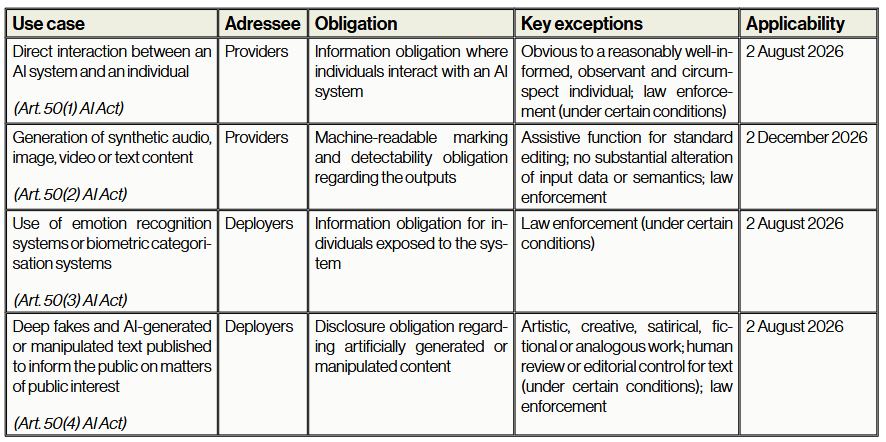
According to Art. 50(5) AI Act the required information must be provided to individuals in a clear and distinguishable manner, and at the latest at the time of the first interaction or exposure.
INFORMATION OBLIGATION WHERE AI SYSTEMS INTERACT DIRECTLY WITH INDIVIDUALS
Providers of AI systems intended to interact directly with individuals must design and develop them so that the persons concerned are informed that they are interacting with an AI system (Art. 50(1) AI Act). A direct interaction requires a real-time or near realtime written, oral, visual or physical exchange between an individual and an AI system; passive data collection (such as facial recognition in access control) or indirect interaction through a third party does not fall within the scope of this obligation.
Examples of systems covered: voice assistants, chatbots (customer support, e-commerce, healthcare...
Get this document and AI-powered insights with a free trial of vLex and Vincent AI
Get Started for FreeStart Your Free Trial of vLex and Vincent AI, Your Precision-Engineered Legal Assistant
-
Access comprehensive legal content with no limitations across vLex's unparalleled global legal database
-
Build stronger arguments with verified citations and CERT citator that tracks case history and precedential strength
-
Transform your legal research from hours to minutes with Vincent AI's intelligent search and analysis capabilities
-
Elevate your practice by focusing your expertise where it matters most while Vincent handles the heavy lifting

Start Your Free Trial of vLex and Vincent AI, Your Precision-Engineered Legal Assistant
-
Access comprehensive legal content with no limitations across vLex's unparalleled global legal database
-
Build stronger arguments with verified citations and CERT citator that tracks case history and precedential strength
-
Transform your legal research from hours to minutes with Vincent AI's intelligent search and analysis capabilities
-
Elevate your practice by focusing your expertise where it matters most while Vincent handles the heavy lifting
